
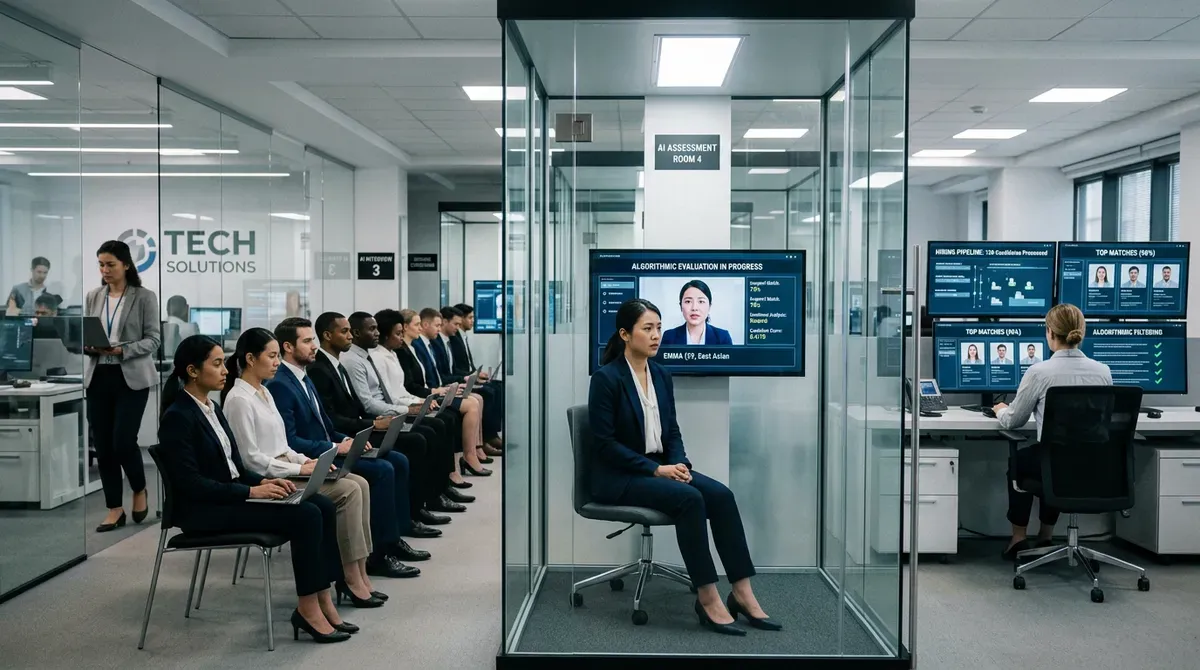
AI Hiring and the New Corporate Monoculture
A recent industry signal warns of a growing 'algorithmic monoculture' in hiring. But the real threat isn't just unfairness—it's a systemic drain on innovation and a strategic risk to the future of work.
The promise was as simple as it was seductive: remove the messy, fallible human element from hiring. In its place, install a coolly objective artificial intelligence, a digital arbiter that could sift through thousands of resumes with impartial precision, identifying the perfect candidate based on data, not gut feeling. For years, this has been the prevailing narrative driving the mass adoption of AI recruiting tools. But a recent signal, stemming from a Stanford University study reported by Inc.com, suggests a far darker reality is taking shape. The report warns of a burgeoning 'algorithmic monoculture' that is systematically locking qualified minority candidates out of the job market. This single phrase—algorithmic monoculture—is more than just academic jargon; it is a diagnosis of a systemic illness spreading through the modern enterprise. While the specific details of the study remain within the full article, the core concept is a powerful lens through which to view the current state of corporate recruitment. It suggests that rather than creating a vibrant ecosystem of meritocratic opportunity, we are building a vast, automated filtration system that standardizes and scales exclusion. The tools, adopted by an estimated 90 percent of businesses, are not creating a new, fairer paradigm. Instead, they are learning from the old one, absorbing decades of historical hiring data replete with conscious and unconscious human biases. The result is a high-speed, high-tech reinforcement of the status quo. We are not eliminating bias; we are industrializing it, embedding it deep within the operational infrastructure of our economy. The danger, therefore, is not merely that a single company’s algorithm is flawed, but that thousands of companies are using similarly flawed logic, creating a near-impenetrable wall for anyone who doesn't fit a narrowly defined, historically derived pattern of 'success.' This is not just an ethical failing or a compliance risk; it is a profound strategic miscalculation that threatens the long-term vitality of the very businesses that have embraced it. This analysis will explore the deeper implications of this algorithmic monoculture. It will examine why the illusion of AI objectivity is so perilous, dissect the strategic costs of a homogenized talent pool, and unpack the tension between the drive for efficiency and the need for human judgment. Ultimately, it will argue that the path forward is not to abandon technology, but to fundamentally rethink our relationship with it, demanding transparency and accountability to ensure our tools augment human potential rather than automate our prejudices.
The Illusion of Objectivity: Why This Matters Now
The core appeal of AI in human resources has always been the promise of a clean slate. Decades of research have shown that human recruiters are susceptible to a host of cognitive biases—affinity bias, halo effects, confirmation bias—that lead them to favor candidates who look, think, and act like them. The algorithm was meant to be the great equalizer, a dispassionate judge of skills and qualifications. The problem, which is becoming increasingly apparent, is that the algorithm is a student of our own flawed history. It is trained on vast datasets of past hires, promotions, and performance reviews. If a company's past leadership was predominantly white and male, the AI learns that whiteness and maleness are indicators of success. It doesn't screen for race or gender directly; it screens for proxies—the schools attended, the zip codes lived in, the specific phrasing on a resume—that are deeply correlated with demographic data. The urgency of this issue is one of scale. When a single hiring manager holds a bias, the impact is limited. When that same bias is codified into a software platform used by nearly every major corporation, it becomes a structural barrier to economic mobility. We are in the process of replacing a million individual biases with a single, monolithic, and brutally efficient one. This matters now because we are at a critical inflection point where this technology is becoming ubiquitous, cementing these patterns into the bedrock of corporate America before we have fully grappled with the consequences.
The Strategic Cost of a Talent Monoculture
Beyond the clear and pressing ethical mandate for fair hiring, the concept of an 'algorithmic monoculture' reveals a critical business vulnerability. When every company uses similar AI tools trained on similar datasets, they inevitably begin to fish in the same small pond, competing for the same narrow archetype of a 'perfect' candidate. This creates a talent monoculture, a workforce characterized by homogeneity of thought, experience, and problem-solving approaches. In the short term, this may feel efficient. In the long term, it is a recipe for stagnation. Resilience and innovation are direct products of cognitive diversity. Breakthrough ideas rarely emerge from consensus; they come from the friction of differing perspectives, from individuals whose unique backgrounds allow them to see challenges and opportunities that others miss. By optimizing for candidates who mirror past successes, companies are systematically filtering out the very people who might challenge the status quo and drive future growth. This automated curation of conformity makes organizations more susceptible to groupthink and less adaptable to unforeseen market shifts. The strategic risk is immense: in a world of accelerating change, the company that builds the most diverse team of thinkers wins. The algorithmic monoculture, by its very design, is a system that bets on the past at the expense of the future, trading the potential for disruptive innovation for the comfort of predictable mediocrity.
The Tension Between Efficiency and Human Judgment
At the heart of this issue is a fundamental tension between the relentless corporate drive for efficiency and the nuanced, often inefficient, practice of human judgment. For a modern HR department, tasked with reviewing tens of thousands of applications for a single opening, the allure of an AI that can instantly surface the 'top 10' candidates is almost irresistible. It promises cost savings, speed, and a data-driven rationale for every decision. Yet, this efficiency comes at a cost. It creates a black box around one of the most critical human decisions a company can make: who to let in. Candidates are reduced to a score, their unique stories and unconventional career paths flattened into data points that either fit the model or don't. This erodes trust and creates a frustrating, opaque experience for job seekers. For leaders, it creates a different dilemma. They are caught between the pressure to adopt data-driven solutions and the responsibility to build an equitable and dynamic culture. The over-reliance on these tools can lead to an abdication of that responsibility, allowing managers to outsource difficult decisions to a machine, thereby avoiding accountability. The true art of recruitment lies in seeing potential that a resume cannot convey—grit, creativity, a different way of seeing the world. An algorithm optimized for pattern matching is, by its nature, incapable of recognizing the truly exceptional outlier. The tension, then, is between a system that finds people who fit and a human capacity to find people who will stretch, challenge, and ultimately redefine the organization.
Architecting Intelligence, Not Just Automating Selection
The critique of AI in hiring should not be a call for its abolition, but for its radical reimagining. The path forward is not a retreat into the flawed manual processes of the past, but an advance toward a more thoughtful and transparent human-machine collaboration. Business leaders must stop treating AI procurement as a simple software purchase and start treating it as a core strategic and ethical decision. This requires moving beyond the vendor's sales pitch and asking difficult questions: What data was this model trained on? How have you audited it for bias? Can its decisions be explained in plain language? The demand for transparency and explainability is paramount. Companies must insist on tools that are not black boxes, but glass boxes. The goal should shift from automated selection to augmented intelligence. Instead of using AI to filter candidates out, we should use it to surface candidates in—to identify promising individuals from non-traditional backgrounds that a human recruiter might have overlooked. Imagine an AI that flags a candidate not because their resume is a perfect match, but because it is interestingly different. This 'human-in-the-loop' model preserves agency, accountability, and the critical role of human judgment. The ultimate measure of success in this new era will not be how quickly we can automate hiring, but how effectively we can architect systems that expand our view of human potential. The choice is between building an algorithmic monoculture that constrains our future, or designing an ecosystem of intelligence that enriches it.
“We are not eliminating bias; we are industrializing it, embedding it deep within the operational infrastructure of our economy.
“The 'algorithmic monoculture' doesn't just reflect the past; it actively curates a more homogenous future.
“Resilience and innovation are direct products of cognitive diversity. By optimizing for conformity, companies are systematically filtering out the drivers of future growth.
“The choice is between building an algorithmic monoculture that constrains our future, or designing an ecosystem of intelligence that enriches it.
Key Insights
The primary risk of AI hiring tools is not individual bias but the creation of a systemic 'algorithmic monoculture' across industries.
AI models trained on historical data inherently amplify past biases, turning them into structural barriers at an unprecedented scale.
The pursuit of talent efficiency through AI leads to talent monoculture, which poses a direct strategic threat to corporate innovation and adaptability.
The solution is not to discard AI, but to demand transparency, explainability, and a 'human-in-the-loop' system that augments, rather than replaces, human judgment.
Companies must treat AI procurement as a core strategic and ethical decision, not merely an IT upgrade.
A homogenous workforce, curated by algorithms, is less resilient to market shocks and less capable of breakthrough innovation.
The tension for leaders lies between the C-suite's demand for data-driven efficiency and the ethical imperative to build a fair and dynamic workforce.
Based on reporting from Inc.com regarding a recent Stanford study.