
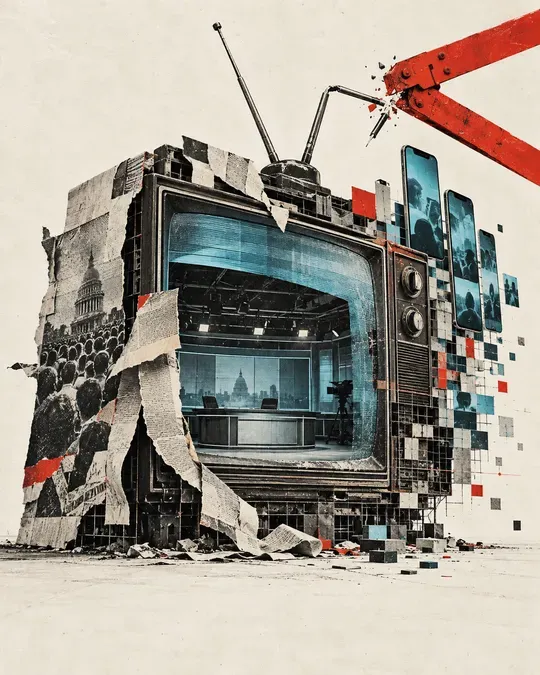
End of an Era: How Political Warfare, AI, and Digital Forces Are Dismantling Legacy Television
For decades, network television operated under a predictable, highly profitable playbook. Sunday nights brought the prestige of broadcast journalism, weeknights offered the comfort of late-night political satire, and a clear wall separated traditional Hollywood from the burgeoning world of internet video. This was the established order, a seemingly unshakeable empire.
However, a flurry of seismic shifts has proven that the old guard is not merely changing—it is being systematically dismantled. From hostile newsroom corporate overhauls and government intimidation to the relentless march of digital algorithms and artificial intelligence, legacy media finds itself fighting a losing war against an unstoppable future.
The Demise of the Prestige Newsroom
For over half a century, CBS’s 60 Minutes stood as the undisputed crown jewel of broadcast journalism—an untouched bastion of traditional, high-budget reporting. That era, defined by its perceived immunity to corporate pressures, has officially ended with a screeching halt.
The explosive firing of veteran anchor Scott Pelley, following an intense clash with management over a sweeping "disruption" and overhaul of the program, sent shockwaves throughout the industry. While remaining correspondents scramble to assure the public of their commitment, the race to steady the ship reveals a grim reality. New corporate leadership, driven by a desire to expand across digital platforms and aggressively cut costs, is forcing a historic news program into the 21st century by force. The "unanswered questions" left in Pelley's wake signal that the era of the untouchable, high-budget investigative broadcast journalist is dead. Content is being ruthlessly streamlined, and no one—no matter how legendary—is safe from the corporate chopping block.
The Late-Night Extinction Event
If Sunday nights were once synonymous with prestige news, weeknights belonged to late-night hosts who often served as the nation's political therapists. That pillar, too, has decisively collapsed.
Stephen Colbert’s Late Show finale brought an emotional, record-breaking end to an eleven-season run. Yet, it wasn’t just a goodbye to Colbert; it was a poignant farewell to the late-night format as a network priority. Strikingly, CBS didn't replace Colbert with another high-priced, politically sharp comedian. Instead, media mogul Byron Allen stepped in to take over the time slot. In a bizarre sign of the financial times, Allen is actually renting the time slot from CBS to air his apolitical, syndication-style show Comics Unleashed. Networks can no longer afford the massive production budgets of traditional late-night television, opting instead for cheap, safe, and "immediately profitable" alternatives that prioritize the bottom line over cultural commentary.
The Digital Invaders: YouTube and AI
As traditional TV hollows itself out, the formats replacing it are rapidly emerging from the internet. While network executives panic over falling ratings and dwindling viewership, YouTubers are setting box office records, fundamentally changing the future of moviemaking and celebrity. Audiences, particularly younger ones, no longer look to network executives to tell them who is a star—they look directly to their algorithms and independent creators.
Compounding this existential threat is the relentless rise of Artificial Intelligence, which is actively harvesting the decades of intellectual property and journalistic work legacy media produced. CNN’s lawsuit against Perplexity over alleged AI copyright theft highlights a desperate legal rearguard action. Legacy companies are belatedly realizing that tech platforms are scraping their expensive reporting and investigative journalism to provide instant answers to users, thereby starving the original creators of the traffic, ad dollars, and recognition they desperately need to survive.
Weaponizing the Airwaves: Government Intervention
To make matters worse for traditional networks, they are no longer just fighting market forces; they are increasingly fighting the federal government itself.
ABC’s open accusation against the FCC of "unconstitutional retaliation" in a station license fight exposes how political figures are using bureaucratic levers to punish networks for their content. By forcing ABC to file early license renewals after public disputes over political commentary, the FCC is signaling that broadcasting on public airwaves now carries immense political risk. This direct government pressure adds another layer of complexity and danger to an already beleaguered industry.
The New Media Landscape: A Fractured Future
When you step back and look at the rapidly shifting battlefield, the trajectory is undeniably clear:
Prestige journalism (e.g., 60 Minutes) is being forced into cheap, multi-platform efficiency, often at the expense of depth and quality.
Late-night institutions (e.g., The Late Show) are being replaced by rented, low-cost syndication blocks, signaling a retreat from cultural relevance.
Independent creators (e.g., YouTubers) are seizing control of entertainment, even taking over the physical box office.
AI companies are absorbing the written archive of the free press, challenging intellectual property and revenue models.
The State is actively squeezing the regulatory throat of traditional broadcasters, adding political risk to an already challenging environment.
The era of turning on the television to see what America is thinking, to share a collective cultural moment, is unequivocally over. Legacy TV is no longer the mirror of the culture—it is merely another fragment in a fractured, digital wilderness, struggling for relevance in a world it no longer dominates.